Sep 24, 2022

A Wake for the Dead in Glenn's Barn


Lunch and Acknowledgments

It was a small but convivial gathering last Saturday at Glenn's.  Eschewing our usual weeknight dinner, Glenn treated us to lunch al fresco and used the Cunard Line's menu from 1908 as his inspiration.  With duck pate, anchovies, stilton cheese, mixed nuts, and smoked salmon for appetizers, Glenn followed with roast beef and browned potatoes for the entrĂ©e and apple pie for dessert.  As we ate in Glenn's beautifully-restored 100-year old barn, we couldn't help but think of the Lusitania's passengers, dining on the same food at the very moment their ship was struck by a German torpedo.  
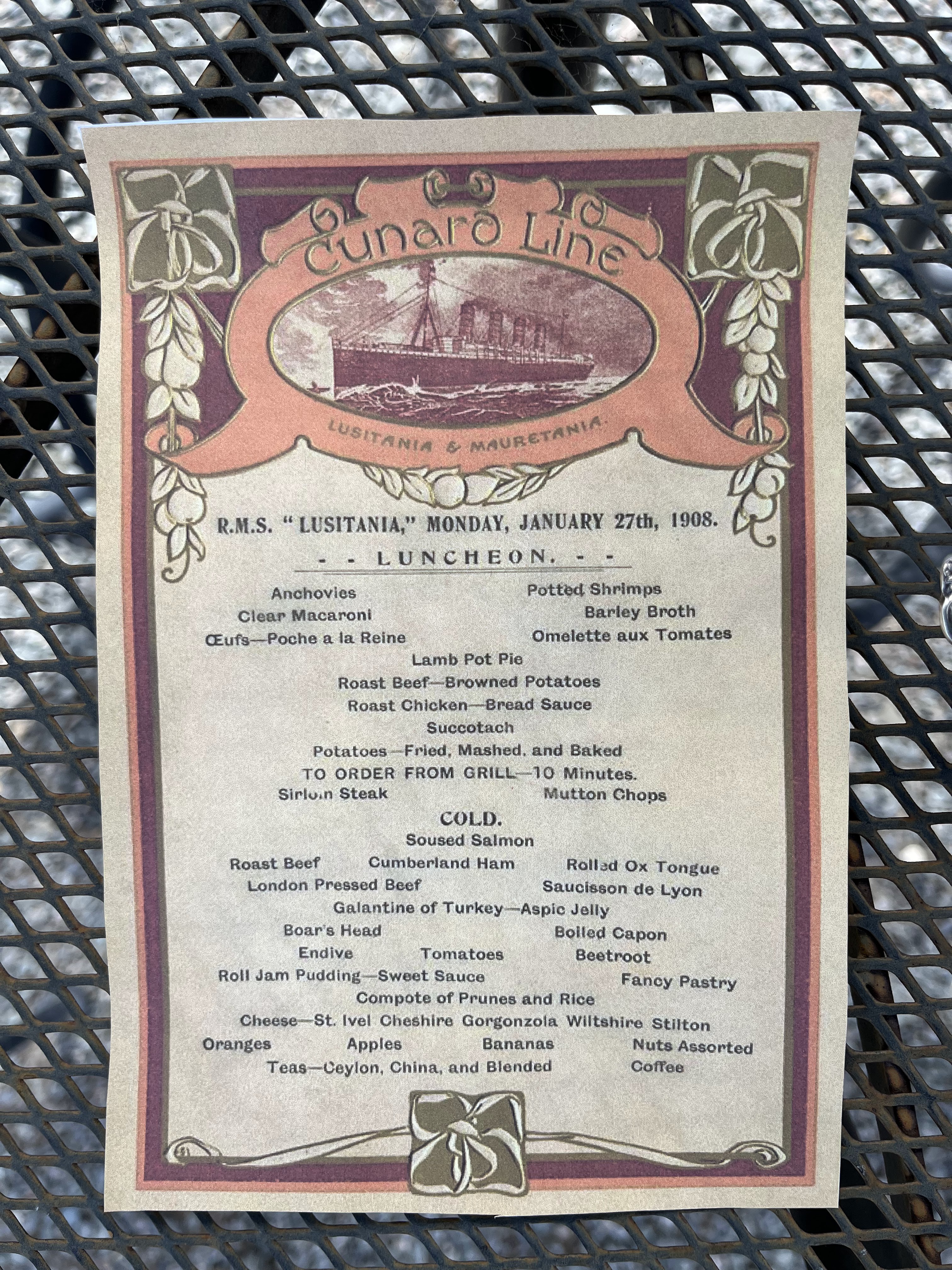
Glenn's copy of the Lusitania's 1908 lunch menu 

Dining with Captain Glenn
Our Review and Discussion of Dead Wake by Erik Larson

Although not as infamous as the Titanic's sinking, Germany's 1915 attack on the Lusitania is known by every student of history as an important reason American sentiment began to shift away from isolationism and in support of the Allied Powers against Germany. With that as background to our discussion, Tom answered our most pressing question in the affirmative.  Yes, despite the book's obvious climax, Dead Wake keeps its reader in suspense throughout. 

Like most books we've read, it's strength of story that wins us over.  And that's where Larson's book shines, with an account both informative and gripping. We learned that Cunard's Lusitania and Mauretania were thought to be unsinkable.  As the fastest ocean liners in the world, they operated at twice the speed of Germany's fastest U-boats. So why was the Lusitania vulnerable?  It was traveling at reduced speed to save Cunard money; its hull was lined with empty coal bunkers which, when filled with sea water after the torpedo explosion, forced the ship to list precipitously; and, most damningly, the English (who'd broken the German Navy's code) knew of the U-boat's presence but refused to alert or escort the Lusitania for fear of compromising their codebreakers or risking their destroyers.

Our admiration for story notwithstanding, Glenn's biggest quibble was ours as well: for a sinking that took only 18 minutes, the reader is fed an awful lot of detail, especially about passengers more colorful than significant, in the course of the book's 353 pages.  (That said, who wouldn't want to know about the passenger who survived being ejected from an underwater smokestack?  Or the passenger torn between saving his original sketches by William Thackeray or his copy of A Christmas Carol with handwritten annotations by Charles Dickens?)   

Our Rating of Dead Wake

Our enjoyment of a good story was tempered by the sobering statistics we learned while reading Dead Wake.  Although the ship sank in calm weather, with ample lifeboats and within sight of the Irish shore, almost 1,200 of its 2,000 passengers died.  Fearing more U-boat attacks, the British Navy ordered its nearby cruiser to withdraw, so a flotilla of fishing trawlers and civilian boats was all that was available to perform search and rescue. The Lusitania was prized as a target, not because of its military importance, but because U-boat captains were recognized for the tonnage of their kills.  As one of the largest vessels afloat, the Lusitania was an irresistible trophy.  

Recognizing a good story, but one weighed down by an excess of detail, we gave Larson a solid 7.4.
  
Next Up:  Hellhound on His Trail by Hampton Sides

Dean gave us an interesting list of contemporary classics (Where the Crawdads Sing, Beloved, A Visit from the Goon Squad) plus the controversial American Dirt.  The voting was close, but we rejected all of them in favor of Hellhound on His Trail, Hampton Sides' account of James Earl Ray's assassination of Martin Luther King, Jr. and the manhunt that consumed a nation.

Jul 1, 2022

Feather Thieves and Salmon at Dan's


Dinner and Acknowledgments

Last Wednesday, Dan's challenge was to prepare a meal themed around a story about the theft of centuries-old bird skins.  He nailed it.  With help from Roy, Dan started us with gravlax and then served freshly-caught cedar plank salmon and roasted chicken, pan-fried corn, salad, and french bread. To close, he put out a batch of homemade chocolate chip cookies and a chaser of aquavit.  

The salmon was a nod to the "salmon flies" at the center of our story, and the chicken stood in for the many feathered species so prized by Edwin Rist and his fly-tying community.  Bravo, Dan!  

Our Review and Discussion of The Feather Thief by Kirk Johnson

Until Dan proposed the title, few of us had heard about the theft of bird skins from London's Natural History Museum in 2009. Moreover, it seemed a slender premise for a book.  But once we started reading, most of us were quite taken by Johnson's non-fiction account of young Edwin Rist and his brazen heist.

Johnson opens with a history of rare and exotic birds in South America and Southeast Asia.  He explains that Englishman Alfred Russel Wallace's acquisition and study of birds in the Malay Archipelago led him to formulate a theory of evolution ahead of Charles Darwin. His work also resulted in the donation of over 125,000 birds to the Natural History Museum, which now boasts the largest ornithology collection in the world.  

As Wallace was collecting birds, women's fashion turned to bird feathers for hats and coats.  At the same time, the gentry in England developed a passion for fly-tying, including so-called "salmon flies," the ne plus ultra of  fishing flies.  As with women's hats, the more exotic the bird, the more desirable its feathers, even though most salmon flies weren't actually used for fishing.  

All of this was prelude to the theft at the heart of Johnson's story.  By the 1990's, making and collecting salmon flies had regained popularity, but the same problem bedeviled current collectors: where to get  exotic feathers whose sale was banned by international law?  Enter Edwin Rist, who while studying at the Royal College of Music to become a flautist broke into the Natural History Museum and stole 299 bird skins.  His capture, trial, and the subsequent search for the missing skins are Johnson's focus in the latter half of the book.  

Our Rating of the The Feather Thief 

Ok, we liked the book, but with some big caveats. First off, several guys (Dean, Terry) noted the parallels to our prior book about Teddy Roosevelt's 1913 exploration of the Amazon (River of Doubt), as Wallace's first ornithology expedition covered similar terrain with as punishing an outcome.  But after building a strong back story, Johnson disappoints following Rist's criminal trial.  As Doug noted, Rist faced no accountability by receiving a suspended sentence.  And as Paul, Jack, Larry, and Roy all observed, once Johnson begins his own search for the missing skins, his failure to find them makes for a deeply unsatisfying ending.  Even our non-fiction devotee Glenn, who likened the obsession with faux fishing flies to the Ming vase obsession, was disappointed by the ending.

Despite our reservations about the ending, we gave Johnson a healthy 6.8 for a fascinating peek into the history of birds and their fly-tying antagonists. 

Next Up: Dead Wake by Erik Larson

We read The Devil in the White City years ago, and have several times suggested other Larson titles, but to no avail.  Finally, we get another chance.  In August, we'll convene at Glenn's to discuss a U-boat, an ocean liner, and a World War.

Feb 28, 2022

Larry's Southern Luncheon


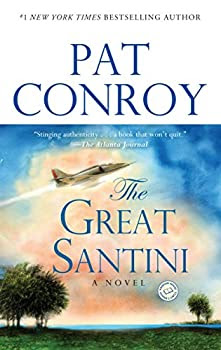
This month’s book was a work of fiction that offered us a trip back to 1960s America in the South.  The book focuses on a boy coming of age within a strict military family, specifically a Marine Air Corps family stationed in Beaufort, South Carolina.  The book’s title refers to the family’s patriarch, Colonel Bull Meechum (nicknamed the Great Santini), who commands his family as though they are another group of young pilots he must whip into Marines.  The book is a thinly-veiled account of Pat Conroy’s own childhood growing up in such a family. 

MBC’s comments focused on Ben Meechum, Bull’s teenage son facing the age-old conflict of children finding their place and voice within a strong patriarchal family.  The book seemed to hit home with MBC as all us are old enough to have grown up in those times.  And all of us are sons and fathers.  The book should be read within the context of the era the book was written/published – 1976 – well before many of the “tell all” Mommy Dearest genre books arrived and the book’s stark description of black life and policing in the South were not common. 

Larry hosted this first MBC gathering of 2022 at his home yesterday.  The weather cooperated and we were able to dine in Larry’s backyard on a beautiful Marin Sunday afternoon with a Mt. Tam backdrop.  And while no mint juleps were seen, Larry did his best to provide a taste of the South with BBQ steaks, grits topped with collard greens, and finishing with homemade pecan pie topped with just churned vanilla ice cream.  The Meechums of the book would have been right at home. 

The book was generally well received by MBC and reflected the old writers’ adage of “write what you know.”  Or in this case write what you lived through, for Ben Meechum reflects the experience of adolescent Pat Conroy.  In several cases the MBC members were able to relate specific aspects of their own childhoods to those of the fictional Meechums. 

Doug loved the story but found Conroy’s writing a bit prosaic and dull.  Andrew found the trip to the 60’s triggered memories of his own father’s parental style – who grew up in the south and attended West Point.  Paul enjoyed it, especially where all the children pile on to stop Bull from bullying their mother.  He found the book to have a sense of humor and a nice character study.  Tom also enjoyed the character development particularly Bull Meechum – a real piece of work.  He found the story well written and readable.  Dean thought the book was well written and saw the book as a series of vignettes built around the family’s dynamics.  He wondered how we would deal with similar situations today – interfering in a basketball game and dealing with an abusive alcoholic father.  Dean also related to the Catholic family and found MaryAnn, the daughter, as compelling a character as Ben.  Having recommended the book, Larry also identified with the itinerant nature of military life having grown up near an Air Force Base and seeing how some military kids were forced to uproot their lives every few years to move to the next posting. 

In the end, the scoring reflected the consistently positive responses among the MBC, with an average rating of 8.1.   

--Larry

Jul 10, 2021

Lost and Found at Armando's Table

men's book club review rating Solnit A Field Guide
Dinner and Acknowledgments

Last Wednesday was only our second dinner together since 2020 and, like our meal in May at Tom's, it was worth the wait. Mando served up a series of classically French dishes whose ingredients had the imprimatur of none other than Claude Monet and our very own Le Comptoir. From the opening cheese selection to the roast chicken, from the potato casserole to the apple pie, c'etait tout magnifique!

Our Discussion and Review of Solnit’s A Field Guide to Getting Lost

Rebecca Solnit’s A Field Guide to Getting Lost is a collection of essays on a seemingly endless variety of topics—from the plot of Vertigo to the travails of Spanish explorer Cabeza de Vaca to a heroin overdose by a close friend—all connected (sometimes flimsily) by the notion that true self-discovery occurs only after one has lost one’s way.

When we picked A Field Guide from Mando’s list of titles last month, we naively thought that we were finally going to understand why it’s better to put away the map. We didn’t expect that Solnit’s path was going to be more metaphysical than literal. Yes, there were the obligatory references to Thoreau's road less traveled and to early explorers relying on maps with too little topography and too much terra incognita. But Solnit’s emphasis on geography was simply to get us in the mood for more serious soul-searching. And that’s where our problems began.

Most of us felt Solnit’s essays were, ahem, all over the map (thanks for the pun, Dan). Her ideas and associations move quickly and at times randomly. Some guys couldn’t follow the thread and others simply lost interest. Worse, her commentary is surprisingly uneven for such an accomplished writer, with trenchant observations and clever asides followed by more than a few clunkers.  To paraphrase Paul, Solnit's ideas were fascinating and frustrating, erudite and interesting, but with no obvious lesson to be drawn from the collection.  (I'm tempted to also paraphrase Dean, who characterized Solnit's stories as David Sedaris writ noir, but my notes don't do his wit justice!)

Rating A Field Guide to Getting Lost

With her intentionally discursive style, Solnit doesn’t make the reader’s task easy. And so we complained, predictably. But she earned our grudging admiration nonetheless. She provoked us with her impressive range, she made us consider our place and our potential, and (for most of us) she had us thinking long after we’d finished the book. So, despite our various disappointments, we gave her effort a respectable 6.1.

Next Up:  Deacon King Kong by James McBride


Doug offered us an excellent list of titles to choose from.  We chose James McBride’s recent novel, but we paused to consider Days Without End (Barry), The River (Heller), and The Splendid and the Vile (Larson).  We’ll decide in August if McBride’s novel about New York in the late 60’s is worth the acclaim it’s received.

Jul 9, 2021

2021 Redux

 A summary of unposted titles from Spring 2021....

 January 2021  
Host - Roy   

Subtitled A True Story of Vengeance and Survival, John Vaillant's account of a man-eating tiger in Russia's Maritime Territory gave us a fulsome education on the wrenching poverty that afflicted Russia's far east after the collapse of the Soviet Union, the endemic corruption that has devastated the tiger's habitat, and the history of the Siberian tiger and its brethren in Africa and the Indian subcontinent.  What it didn't offer was a concise story.  After a promising start, in which we learn about and applaud the tiger's killing of a local poacher, Vaillant veers off into lengthy digressions about Soviet-era politics, the Russo-Japanese war, the consumer economy in China, the plight of early man in sub-Saharan Africa, etc.  After occasional updates on the activities of the marauding tiger, Vaillant does return in the final 30 pages to finish the story of how the tiger was eventually tracked and killed.  He doesn't, however, answer the question implicit in the subtitle, as we are never quite sure whose survival is at stake in this most bleak of environments.  Rating: 7.2

 February 2021  
Host - Peter  

While Peter did offer News of the World for our consideration, we clearly disappointed him by not opting for one of his more substantial titles (Far From the Tree-Solomon; The Known World-Jones; Necessary Lies-Chamberlain; and The Return-Matar).  At 208 pages, Paulette Jiles gave us (and Hollywood, since it was recently made into a film starring Tom Hanks) a short, endearing story about a Civil War veteran who's agreed to escort across Texas a young girl recently freed from Indian captivity.  The book contains all of the ingredients needed for a successful movie:  a sympathetic protagonist bound by a sense of duty, menacing bad guys (and few good ones for contrast), an arduous but successful journey, and a bond created during that journey that produces the novel's climax.  OK, so it was predictable and at times corny, but it proved an enjoyable read.  Indeed, that was the most common adjective used during our Zoom discussion.  Misgivings aside, we liked the Civil War and Reconstruction history, Captain Kidd's livelihood as a reader of news in a time of deep political polarization, and the brief but sympathetic treatment of Joanna's captors, the Kiowa, and their Comanche allies.  Rating: 7.4

April 2021  
Host - Andrew  

Kevin Barry's novel about two aging Irish gangsters waiting expectantly one night at the Port of Algeciras has been on everyone's list of books to read.  And it's been on ours as well. Offered but rejected in the past, I resurrected it alongside Homeland Elegies (Akhtar), The Abstainer (McGuire), The Splendid and the Vile (Larson), and Fortune Smiles (Johnson).  For most, our selection was vindicated by an appreciation for Barry's poetic dialog, his unforgettable characters, and the building suspense he creates out of a series of flashbacks.  Were it not for our American ears, we might all have given it a full thumbs-up as Doug did.  But the fact that Barry had us running for the Irish-English dictionary slowed many of us down. While I found pleasure in reading quickly and ignoring the unfamiliar references, I was in the minority.  All of us, however, were engaged by the gangsters' back story and intrigued by the significance each of the two men places on the elusive Dilly (for whom they are waiting) and her mother (whose death they both grieve).  Rating:  7.8

May 2021  
Host - Tom  

When Tom told us we were finally going to dine in person, and he offered us a choice of Krueger's This Tender Land,  Weiner's The Geography of Bliss, Proulx's Bad Dirt, and Sides' Hellhound on His Trail to accompany our meal, he figured he'd also toss in a book about food just for kicks.  And that's how we ended up with Anthony Bourdain's book about his televised quest for the most compelling meals in the most exotic places around the world.  After a 14-month hiatus, with only Zoom meetings to sustain our reading, the promise of real food and a discussion of same proved irresistible.

Let's dispense with the book first.  It featured interesting locales and passable writing, with a few compelling stories intermixed with just as many forgettable ones.  What was most memorable about the reading were the occasional anecdotes--his time in France with his brother, his reflections crossing North Africa, his depression in Indochina--that foretold Bourdain's subsequent suicide.  While many of the dishes were enticing (and some utterly repelling), Bourdain's travelogue was bittersweet from start to finish.  

Our dinner, on the other hand, was a pure pleasure from start to finish.  With 15 guys in attendance (including our good friend Mark), and a table groaning with BBQ chicken and ribs and assorted sides, we spent less time on the book and more time simply eating and catching up.  Fully-vaccinated and guided by the latest from the CDC, our dinner was the first large indoor gathering most of us have enjoyed since the onset of Covid.  What a terrific way to return to normalcy!