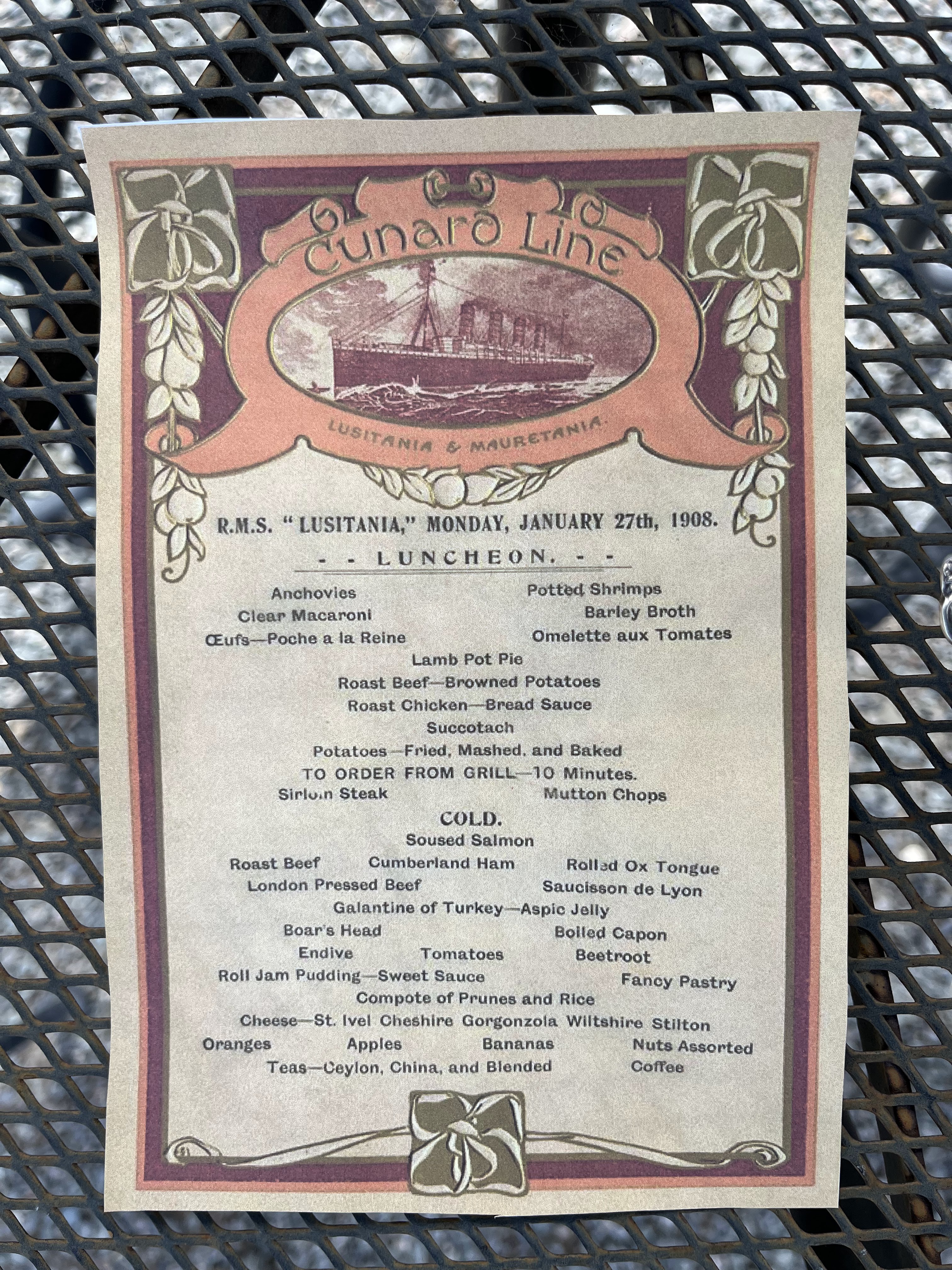
After Paul's phenomenal luncheon in July 2023, MBC continued reading and eating, but its online posts went quiet. Thanks to Larry's initiative, our blog posts resumed last May. What happened during our hiatus? Here's a condensed account, with apologies to certain hosts (and authors) for more than a few omitted details:
September 2023 Host - Larry
We met at Larry's to dine on beef/rice/corn/almonds (yes, those are my notes!) and talk about Ishiguro's (then) latest novel, a prescient tale of AI embodied in a robot named Klara. Purchased as a companion for a sickly child, Klara develops an intelligence and sensitivity that forces one to ask what it means to be human and to love. As a group, we didn't love the book but we found ourselves deeply affected by its characters and the ambition of its author. For that, we gave it an
8.0.

Stan hosted us for our discussion of Geraldine Brooks' novel Horse. Since our meals are often themed with our books, Stan avoided uncomfortable questions about the provenance of his entrée by serving seafood, not red meat. Once we'd tucked in and begun discussing the book, a clear consensus emerged: no one liked the modern frame story, but everyone liked the novel's inner story.
The development of American horse racing in the south, as illustrated by the champion Lexington (whose offspring included the famed Preakness), and the role of the enslaved trainers and groomsmen, was a story fascinating unto itself. What was not fascinating was the forced 21st century story of art, love, and racism. Nor were we persuaded by the sanitized diction of Brooks' 19th century characters. (The use of the word "slave" is studiously avoided by both oppressor and oppressed.)
Due to its length, we read Kingsolver's much-acclaimed Demon Copperhead over two months. In December, 2023 we and our spouses dined in Glenn's barn and shared passing comments about the novel. But only passing, because Glenn's food and venue were too distracting to allow for more. Then in January, 2024, we retreated to Doug's for a fuller discussion of this 2023 Pulitzer Prize winner. (We also enjoyed Doug's roast pistachio salmon and his two excellent desserts--a whiskey cake and a toffee cake, the former perhaps a reminder of the substance abuse so central to our story?)Yes, the novel is long, and yes it's a re-telling of David Copperfield, but it's populated with an unforgettable cast of characters drawn from rural Appalachia (U-Haul, Fast Forward, Maggot, Angus, and of course Demon himself). We found Kingsolver's narrative about the cycle of poverty, domestic violence, and opiate addiction uplifting in spite of its themes. Our comments said it all: "among my top 5" (Andrew), "did not want it to end" (Jack), "great characters" (Glenn), "fascinating" (Roy), "developed a complex relationship with the book" (Paul, who always develops a complex relationship with our books), and "puts Hillbilly Elegy to shame" (Doug). Our effusive reaction pushed Demon Copperhead to the top of our ratings with an 8.9.
Dean hosted us in February for a discussion of Toni Morrison's 1988 Pulitzer winner, Beloved. Naturally, we ate as our novel's characters ate--or rather, as they fantasized about eating. Dean's turkey, homemade bread, butter, and blackberry pie were taken from the meal enjoyed by the novel's protagonists (all escaped slaves) just prior to the arrival of the bounty hunters.
In April, we gathered at Terry's to share our reactions to Kingdoms of Savannah, a mystery set in today's south but with the legacy of slavery haunting the margins of every page. Alas, we were not impressed. But we were impressed by Terry's menu. With oven-fried chicken, beans, mashed potatoes, biscuits, and chocolate cake, Terry's version of southern comfort food was pitch perfect.
Our book in June gave Roy the perfect opportunity to display his Japanese culinary skills. Accompanying the freshly-caught panko halibut was an egg custard (Chawanmushi), spinach salad with black sesame (Goma-ae), a cucumber salad (Namasu), and bean sprout with sesame and vinegar (Moyashi).
When Tom hosted us in August, he served us old-fashioned southern food to aid our discussion of a middle-aged man's return home to Memphis, at the request of his sisters, to deal with his father's infatuation with a much younger woman. Despite its 1987 Pulitzer Award for Fiction, Peter Taylor's finely-etched story of marital, sibling, and generational conflict failed to interest us nearly as much as Tom's menu for the evening.
In September Jack introduced MBC to Dennis Lehane and his 2023 novel about family, race, and mob politics during Boston's 1974 school desegregation crisis. With some criticism for its "beach read" feel and its pat ending, we mostly found Small Mercies to be a worthy end-of-summer escape.
In October, we convened at Larry's for a delicious paella and a spirited discussion of Percival Everett's 2001 satirical novel, Erasure. Any discussion of Erasure is complicated by the nested narratives that Everett clearly had fun assembling. The reader learns at the end that the story is in fact a movie about a story about a book written by an impoverished academic posing as a Black street kid with an authentic new voice. The whole thing is a send-up, the ultimate meta-narrative. So our comments on the story wandered into and out of the main story and the street kid's story (aptly named Fuck) with mostly appreciation for Everett's cleverness.
At 945 pages, and in clear violation of our 500-page limit, Lonesome Dove required an extra month of prep, which meant we met next in January. The delay was worth it: Paul treated us to a feast of Old West-inspired fare, with appetizers of crickets in molasses, a single roast dove (lonesome indeed!), and cowboy skillet bread. The rest of the meal (vegetarian chili, pork adovada, brown and white rice, corn bread, and blueberry cobbler) was almost anti-climactic. Even with our stomachs full, we found much to dissect, share, and ultimately praise in McMurtry's magnum opus. Despite its flaws and its age, Lonesome Dove's greatest virtue is its storytelling, with characters both convincing and compelling. And with few exceptions, it held us captive for almost 1,000 pages. For that, McMurtry's 1985 novel ascended to the top of our ratings with a 9.0.
March 2025 Host - Dan
After a string of novels, Dan brought us back to non-fiction with an account of the rise and fall of Venezuela under the Chavez/Maduro regime. Fortunately, the food scarcity endemic in today's Venezuela had no effect on our meal, as Dan plied us with a delicious all-Venezuelan menu of stew, beans, rice, plus a tasty chocolate cake courtesy of Penny.
If Brooks' intention was to prod her reader into seeing and thinking about a southern economy built on slavery, it certainly worked. If not for the clumsy framing of an otherwise interesting episode in American history, we might have rated it higher than 6.5.

Due to its length, we read Kingsolver's much-acclaimed Demon Copperhead over two months. In December, 2023 we and our spouses dined in Glenn's barn and shared passing comments about the novel. But only passing, because Glenn's food and venue were too distracting to allow for more. Then in January, 2024, we retreated to Doug's for a fuller discussion of this 2023 Pulitzer Prize winner. (We also enjoyed Doug's roast pistachio salmon and his two excellent desserts--a whiskey cake and a toffee cake, the former perhaps a reminder of the substance abuse so central to our story?)Yes, the novel is long, and yes it's a re-telling of David Copperfield, but it's populated with an unforgettable cast of characters drawn from rural Appalachia (U-Haul, Fast Forward, Maggot, Angus, and of course Demon himself). We found Kingsolver's narrative about the cycle of poverty, domestic violence, and opiate addiction uplifting in spite of its themes. Our comments said it all: "among my top 5" (Andrew), "did not want it to end" (Jack), "great characters" (Glenn), "fascinating" (Roy), "developed a complex relationship with the book" (Paul, who always develops a complex relationship with our books), and "puts Hillbilly Elegy to shame" (Doug). Our effusive reaction pushed Demon Copperhead to the top of our ratings with an 8.9.

Dean hosted us in February for a discussion of Toni Morrison's 1988 Pulitzer winner, Beloved. Naturally, we ate as our novel's characters ate--or rather, as they fantasized about eating. Dean's turkey, homemade bread, butter, and blackberry pie were taken from the meal enjoyed by the novel's protagonists (all escaped slaves) just prior to the arrival of the bounty hunters.
Our enthusiasm waned though when it came time to share our reactions to the book. A rewarding read? Maybe. A painful read? Absolutely. From the outset, Morrison makes it clear the reader's on an arduous journey. Her characters suffer almost unendurable trauma, only to realize that freedom cannot exorcise the pain of memory. Morrison's famous line aptly reflects her characters' pain and her white reader's guilt: "...the future was a matter of keeping the past at bay." Before we set aside our discomfort, we applauded Morrison with an 8.0.

In April, we gathered at Terry's to share our reactions to Kingdoms of Savannah, a mystery set in today's south but with the legacy of slavery haunting the margins of every page. Alas, we were not impressed. But we were impressed by Terry's menu. With oven-fried chicken, beans, mashed potatoes, biscuits, and chocolate cake, Terry's version of southern comfort food was pitch perfect.
On the surface, Green's novel had the earmarks of a successful southern gothic mystery: a wealthy, landed class bent on protecting its own, a matriarch whose dysfunctional family eventually pulls together, and a murder whose investigation sets fire to it all. Unfortunately, it had a dime store paperback feel (Jack), plenty of misogyny and twisted characters (Paul), a candy high after our previous titles (Dean), and was overwrought and unbelievable (Doug). The most interesting plot development (i.e., the revelation that the island targeted for development was the ancestral home of free Blacks who fought for the British during the Revolutionary War) is saved for the end, but by then it was too late for most us. Our 6.0 rating said it all.

Our book in June gave Roy the perfect opportunity to display his Japanese culinary skills. Accompanying the freshly-caught panko halibut was an egg custard (Chawanmushi), spinach salad with black sesame (Goma-ae), a cucumber salad (Namasu), and bean sprout with sesame and vinegar (Moyashi).
His bounty contrasted with the bleak post-war environment depicted in No-No Boy, which chronicled the struggles of Japanese-American men who, while interned during WWII, were given loyalty questionnaires. Those who, for reasons of conscience or principle, answered "No" and refused to serve in the US military were sent to a federal penitentiary.
We all were deeply moved by the plight of the novel's protagonist, Ichiro, who returns to Seattle after the war and can find neither work nor a place in the Nisei community. We were also touched by Larry's account of his family's internment experience. However, we were not impressed by the quality of the narrative: few likable characters (including the protagonist), aimlessly plotted, and an ending without closure. If not for its evocation of a seminal moment in our nation's history, No-No Boy would not have earned our modestly positive 6.9 rating.
August 2024 Host - Tom

When Tom hosted us in August, he served us old-fashioned southern food to aid our discussion of a middle-aged man's return home to Memphis, at the request of his sisters, to deal with his father's infatuation with a much younger woman. Despite its 1987 Pulitzer Award for Fiction, Peter Taylor's finely-etched story of marital, sibling, and generational conflict failed to interest us nearly as much as Tom's menu for the evening.
The writing was fine in an old-fashioned sort of way, but there was too little to sustain our interest. As a quiet study of southern manners, the story might have worked. But when the message is simply that there's no escaping 1) your southern roots, 2) your domineering father, or 3) your own miserable relationship, our response is: 1) it's unsatisfying, and 2) it ain't Faulkner. Garth's comment was the most damning: the book felt like Ambien laced with Thorazine.
September 2024 Host - Jack

In September Jack introduced MBC to Dennis Lehane and his 2023 novel about family, race, and mob politics during Boston's 1974 school desegregation crisis. With some criticism for its "beach read" feel and its pat ending, we mostly found Small Mercies to be a worthy end-of-summer escape.
Primed with Jack's excellent shepherd's pie, we dug into Lehane's murder mystery in South Boston and found ourselves mired in a discussion of the effects of school desegregation in the 1970s. Dean saw it in San Francisco, Roy lived through it in Indiana, and Stan experienced it in Marin County. Tom, on the other hand, noted that his large public high school in Siskiyou County was almost entirely white. With those asides, we concluded that the strength of Lehane's novel (apart from a mystery well told) was its ability to paint the various shades of hate and racism in convincing detail. For that, we awarded him a 7.5.
October 2024 Host - Larry

In October, we convened at Larry's for a delicious paella and a spirited discussion of Percival Everett's 2001 satirical novel, Erasure. Any discussion of Erasure is complicated by the nested narratives that Everett clearly had fun assembling. The reader learns at the end that the story is in fact a movie about a story about a book written by an impoverished academic posing as a Black street kid with an authentic new voice. The whole thing is a send-up, the ultimate meta-narrative. So our comments on the story wandered into and out of the main story and the street kid's story (aptly named Fuck) with mostly appreciation for Everett's cleverness.
Doug chided us for falling into the very trap set by the novel's protagonist, a professor who is so white in culture and upbringing that he has to contrive a ghetto story written by a fictional hoodlum in order to sell his work. But we didn't mind. Dean liked the Grateful Dead reference in Stagg R. Leigh's name; Larry appreciated the novel's focus on racial identity and belonging; Paul and Glenn enjoyed the implicit taunt to like the story or be seen as racist; and Terry, always the outlier, suggested that the book had virtually nothing to do with race but was merely about selling a winning formula. We gave the book an 8.2 for its "novel" approach (Stan's pun), and we excoriated Terry for his iconoclasm.
January 2025 Host - Paul

At 945 pages, and in clear violation of our 500-page limit, Lonesome Dove required an extra month of prep, which meant we met next in January. The delay was worth it: Paul treated us to a feast of Old West-inspired fare, with appetizers of crickets in molasses, a single roast dove (lonesome indeed!), and cowboy skillet bread. The rest of the meal (vegetarian chili, pork adovada, brown and white rice, corn bread, and blueberry cobbler) was almost anti-climactic. Even with our stomachs full, we found much to dissect, share, and ultimately praise in McMurtry's magnum opus. Despite its flaws and its age, Lonesome Dove's greatest virtue is its storytelling, with characters both convincing and compelling. And with few exceptions, it held us captive for almost 1,000 pages. For that, McMurtry's 1985 novel ascended to the top of our ratings with a 9.0.

After a string of novels, Dan brought us back to non-fiction with an account of the rise and fall of Venezuela under the Chavez/Maduro regime. Fortunately, the food scarcity endemic in today's Venezuela had no effect on our meal, as Dan plied us with a delicious all-Venezuelan menu of stew, beans, rice, plus a tasty chocolate cake courtesy of Penny.
As to the book, our discussion languished at times. The problem with discussing non-fiction is that it's rarely interesting to recite facts to others who read the same facts. Facts need context, and Neumann provided some, but mostly he just expanded a series of articles (he was the NYT's bureau chief in Caracas) into a book. Our takeaways included: yes, the erosion of democracy in Venezuela's early days of Chavismo feels eerily similar to what we see here today; Venezuela's long decline into authoritarianism can be attributed to a national fascination with strong leaders; and Venezuela's massive oil wealth proved to be its downfall. For a narrative both interesting, tedious, and depressing, we couldn't muster better than a 6.7 rating.